Now accepting new patients in Rockville. Free 15-minute call to figure out where to start.Patient Portal →
Cortisone injections work quickly, but most patients notice they wear off faster with each round, and some stop working altogether. If you’re in that position, dealing with chronic knee, shoulder, or tendon pain that keeps coming back, PRP (platelet-rich plasma) therapy is often the logical next step. Unlike cortisone, which suppresses inflammation temporarily, PRP uses growth factors concentrated from your own blood to support actual tissue repair, and 2025 clinical data consistently shows it outperforms cortisone for lasting pain relief at six to twelve months.
At The Osteopathic Center for Healing, PRP is the most common entry point for patients in Rockville, Bethesda, Potomac, and Gaithersburg who are done managing their pain and ready to work on healing it. If you’ve been searching for “why did my cortisone shot stop working,”“PRP injection near Rockville MD,” “best alternative to cortisone for knee pain Bethesda,” or “non-surgical tendon treatment Potomac,” this page will give you straight answers.
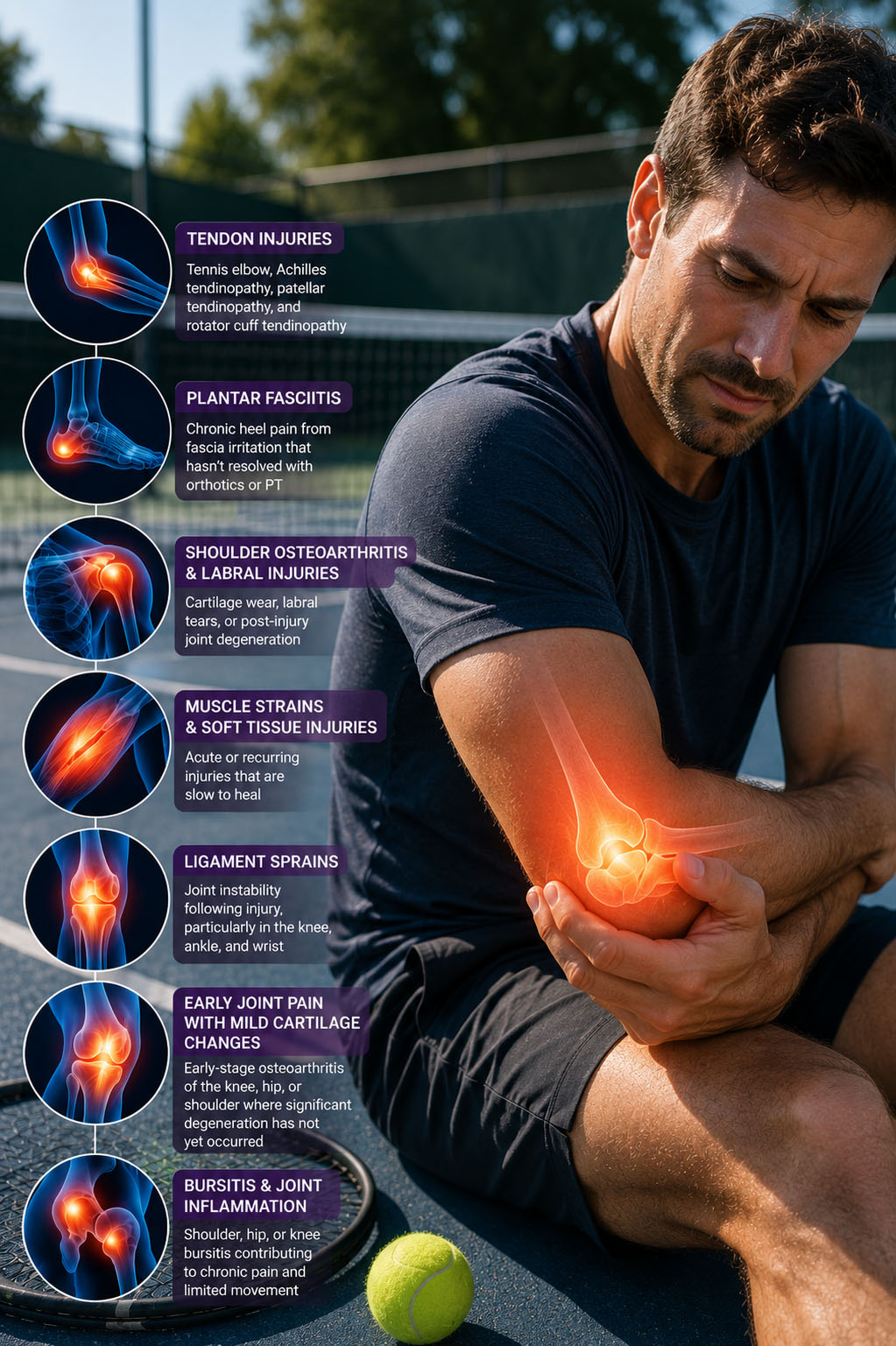
PRP is Dr. Spiegel’s preferred first-line regenerative option for tendon injuries and soft tissue conditions. It is also used for early joint pain where cartilage degeneration is mild. When degeneration is more significant, meaning the cartilage has meaningfully worn down or a labral injury is involved, Dr. Spiegel will typically recommend adipose autograft therapy or BMAC instead, or in combination.
PRP is generally the starting point for patients with tendon and soft tissue pain, and a strong option for early joint changes. For patients with established cartilage degeneration or osteoarthritis of any joint, Dr. Spiegel will discuss whether PRP alone is appropriate or whether adipose or BMAC therapy is a better fit.
PRP is generally recommended as a first-line regenerative option for mild to moderate conditions, or as the starting point of a layered treatment plan for more complex cases.
Many patients come to us after getting repeated cortisone shots that provided diminishing returns. This is consistent with what the research shows: cortisone injections tend to outperform PRP in the first four weeks, but PRP consistently delivers better outcomes at six to twelve months, with less wear on the joint over time. A 2025 meta-analysis of 56 randomized controlled trials confirmed that PRP significantly outperforms both placebo and corticosteroids for chronic joint pain at six and twelve months. Unlike cortisone, PRP doesn’t suppress tissue or mask pain. It works by delivering a concentrated dose of your body’s own growth factors directly to the injured area to stimulate actual tissue repair.
Effect of Platelet Rich Plasma Versus Placebo or Corticosteroid for Knee Osteoarthritis: A Systematic Review and Meta Analysis of Randomized Controlled Trials (2025) https://www.sciencedirect.com/science/article/pii/S0976566224005393
Efficacy and Safety of Intra-articular Platelet-Rich Plasma (PRP) Versus Corticosteroid Injections in the Treatment of Knee Osteoarthritis: A Systematic Review of Randomized Clinical Trials (2025) https://pmc.ncbi.nlm.nih.gov/articles/PMC12010028
Patients with earlier-stage arthritis or tendon injuries often see the most durable results. For more advanced conditions, PRP may be combined with BMAC or used as part of a maintenance strategy. Dr. Spiegel will help you understand what’s realistic for your specific situation.
Platelet-rich plasma and corticosteroid injection for tendinopathy: a systematic review and meta-analysis (2025)
https://link.springer.com/article/10.1186/s12891-025-08566-3
The information on this page is for educational purposes only and does not constitute medical advice. Only a licensed healthcare provider can evaluate whether PRP therapy is appropriate for your individual condition, imaging findings, and health history

Discover lasting relief with Perineural Injection Therapy, Prolotherapy, and Osteopathic Manipulation. Our personalized treatments target pain at its source, helping you regain comfort and mobility.

Our goal is to restore the function and structure of damaged tissues and adipose stromal vascular tissue using innovative regenerative therapies such as bone marrow aspirations and platelet rich plasma (PRP).

Our individualized, patient-centered, science-based approach allows patients and practitioners to work together to address the underlying causes of disease and promote optimal wellness

Achieve radiant, youthful skin with professional-grade treatments and products. From injectables and microneedling to Tixel skin resurfacing and sclerotherapy, our advanced solutions are designed to rejuvenate and restore your natural beauty.
Have questions or ready to take the next step toward better health? We’re here to help! Contact us today to get your questions answered or schedule your appointment. Let’s work together to achieve your wellness goals!
Call Us
Email Us
Answer one quick question and grab a time for your free 15-minute consult.