
Adipose Autograft Therapy for Joint Pain
A Natural, Non-Surgical Option When Other Treatments Have Stopped Working
If your cortisone shots have stopped working, your doctor has mentioned joint replacement, or you’ve been managing knee, hip, or shoulder pain that just won’t resolve, you’re probably searching for something more lasting. Adipose autograft therapy is a regenerative procedure that uses your own body’s fat tissue to support healing at the source, without surgery, synthetic materials, or lengthy recovery time.
Patients who come to The Osteopathic Center for Healing from Rockville, Bethesda, Potomac, and Gaithersburg are often at that crossroads, done with short-term fixes, not ready for surgery, and looking for a treatment that works with their body rather than around it. If you’ve been searching for “non-surgical joint pain treatment near me,” “natural alternative to cortisone injections,” or “how to avoid knee replacement in Bethesda,” this page is written for you.
When Is Adipose Autograft Therapy Recommended?
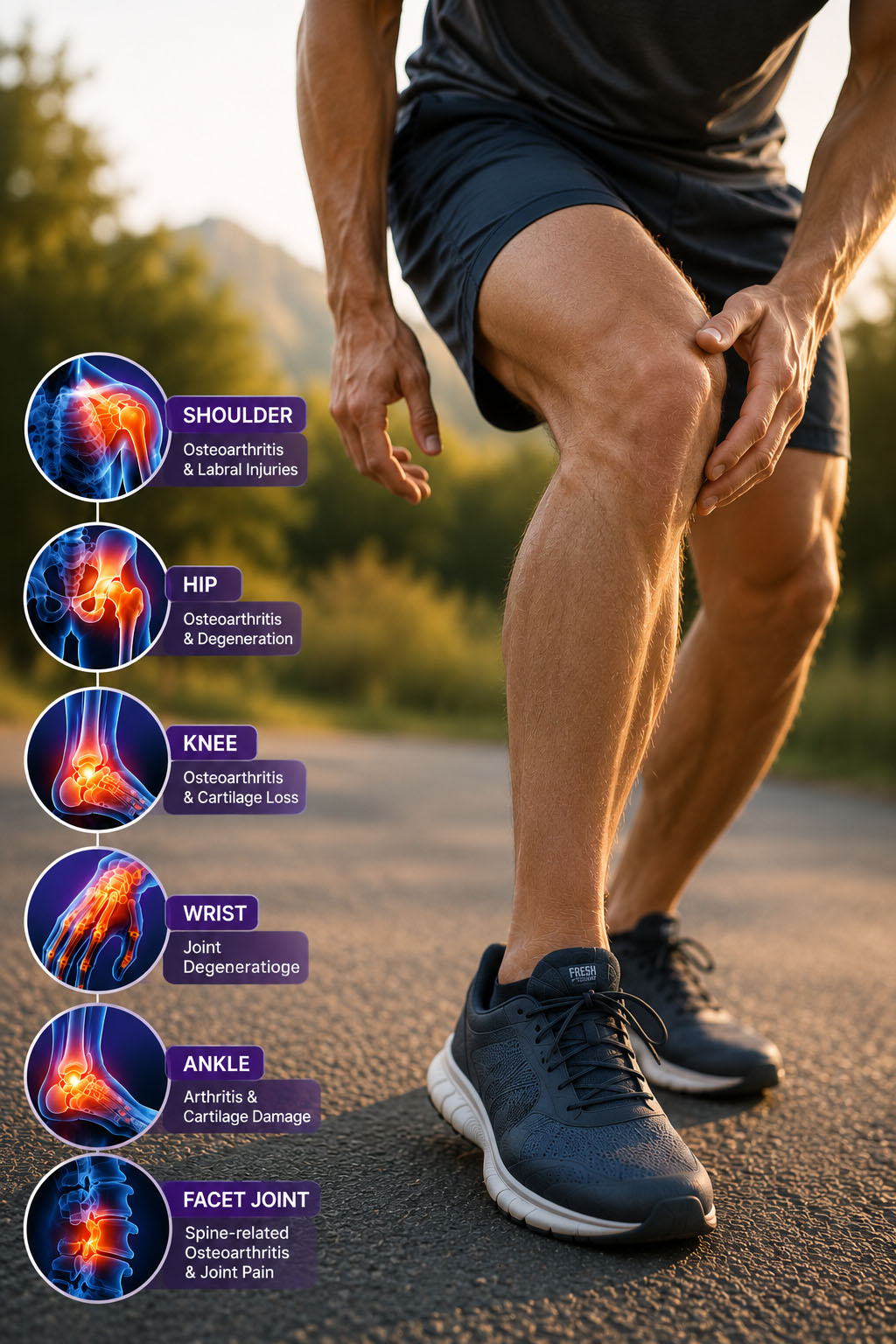
Dr. Spiegel typically recommends adipose autograft therapy for patients dealing with cartilage degeneration, osteoarthritis, or labral injuries, in any joint of the body. When a joint has degenerated over time, whether from age, wear, or injury, the cartilage and surrounding tissue lose their ability to repair themselves on their own. Adipose therapy is designed to support that process from within.
- Knee osteoarthritis: cartilage loss and joint degeneration causing stiffness, swelling, and pain with movement
- Hip osteoarthritis and degeneration: reduced range of motion, groin or outer hip pain, and joint space narrowing
- Shoulder osteoarthritis and labral injuries: cartilage wear, instability, or labral tears affecting function and comfort
- Ankle and wrist joint degeneration: post-traumatic arthritis or chronic cartilage damage in smaller joints
- Hip labral tears: cartilage-related instability and deep joint pain that hasn’t responded to conservative care
Facet joint degeneration: spine-related osteoarthritis causing localized or radiating joint pain - Facet joint degeneration: spine-related osteoarthritis causing localized or radiating joint pain
In short: if the source of your pain is a joint that has degenerated, whether that’s the knee, hip, shoulder, or another joint, adipose autograft therapy may be appropriate. Patients from Rockville, Bethesda, Potomac, and Gaithersburg frequently choose this approach when cortisone shots have run their course and surgery isn’t the next step they’re ready to take.
How Is Adipose Therapy Different from
PRP or Bone Marrow
Treatments?
Patients often ask how adipose therapy compares to PRP or BMAC. The distinction Dr. Spiegel makes is clinical: adipose autograft therapy and BMAC are most appropriate when the issue is cartilage degeneration, osteoarthritis, or labral damage, conditions where the joint structure itself has deteriorated. PRP is typically better suited to tendon and soft tissue injuries. That said, some patients benefit from a combination approach, and Dr. Spiegel will recommend what makes sense based on your imaging and history.
How the Procedure Works
A small amount of fat tissue is gently collected from a donor site on your body, most commonly the abdomen or flank, using a minimally invasive technique performed under local anesthesia. The regenerative components within the tissue are then processed and precisely injected into the targeted joint or soft tissue area under image guidance. Because everything comes from your own body, the risk of immune rejection is extremely low.
What to Expect: Before, During, and After
- In-office procedure, no hospital stay required
- Performed under local anesthesia with minimal discomfort
- Mild soreness at the collection and injection sites for several days
- Most patients return to light activity within a short period
- Gradual improvement that builds over several weeks to months
Am I a Candidate?
You may be a good candidate for adipose autograft therapy if you:
- Have chronic joint or soft tissue pain that hasn’t responded to physical therapy, anti-inflammatory medications, or cortisone injections
- Want to explore natural, non-surgical options before pursuing joint replacement
- Have been told you’re ‘not quite ready for surgery’ but are still dealing with significant pain
- Are looking for a treatment that uses your own tissue rather than synthetic or donor-derived materials
Why The Osteopathic Center for Healing
- Board-certified physician with advanced regenerative medicine training and image-
guided injection expertise - Personalized protocols, no one-size-fits-all approach
- Conveniently located for patients in Rockville, Bethesda, Potomac, and Gaithersburg
Frequently Asked Questions
About Adipose Autograft Therapy
What is adipose autograft therapy used for?
How does fat injection for joint pain compare to cortisone or hyaluronic acid?
Is adipose therapy the same as Lipogems?
How long does adipose autograft therapy last?
Is this covered by insurance?
The information on this page is for educational purposes only and does not constitute medical advice. Only a licensed healthcare provider who has reviewed your individual medical history can determine whether this treatment is appropriate for you.
Make an Appointment
Have Questions?
Have questions or ready to take the next step toward better health? We’re here to help! Contact us today to get your questions answered or schedule your appointment. Let’s work together to achieve your wellness goals!
Call Us
(301) 231-5050
Email Us